
Cancer cells can be intrinsically dependent on oxidative phosphorylation activity (OxPhos) or acquire dependence on OxPhos as a metabolic response to circumvent various therapies. In either case, dependence on OxPhos represents a vulnerability that an OxPhos inhibitor like lixumistat (IM156) is designed to exploit.
For approximately 59% of cancer cases no actionable target/therapy exists. Some of these cancers are intrinsically dependent on OxPhos for their growth and proliferation. For example, a recently defined pathway biomarker has been developed that identifies a subset of glioblastoma multiforme (GBM) patients whose tumors are OxPhos-dependent. Lixumistat, ImmunoMet's OxPhos inhibitor, may provide unique clinical benefit to this subset of patients.
Unfortunately, many cancer patients who initially respond to treatment will relapse. This is true across many tumor types, including pancreatic cancer, breast cancer, melanoma, and GBM. Recently, studies have shown that acquiring of resistance to effective treatments is often associated with a metabolic shift to a dependence on OxPhos for cellular energy and building blocks. Consistent with its mechanism of action as an OxPhos inhibitor, lixumistat may offer a novel anti-cancer approach to patients that have acquired resistance via metabolic remodeling.
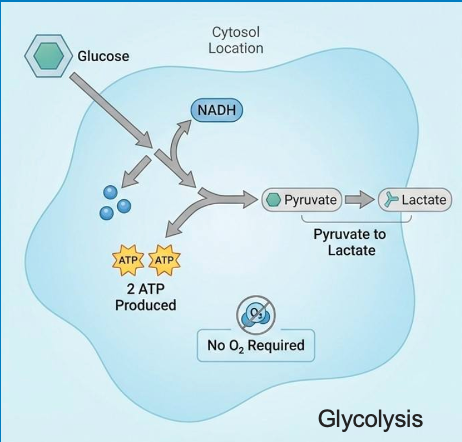
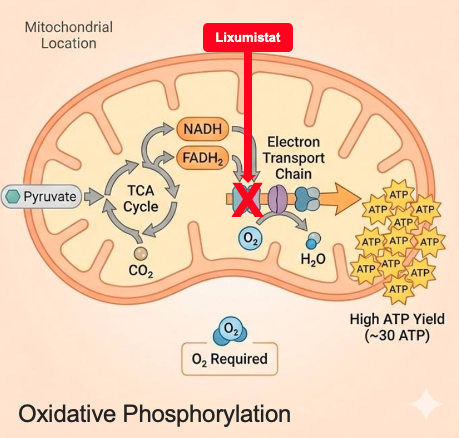
Glycolysis and oxidative phosphorylation are key metabolic pathways that provide cells with the energy they require to grow and proliferate. In the 1920s, Otto Warburg and colleagues made the observation that tumors were taking up enormous amounts of glucose compared to what was measured in the surrounding tissue. His work led to the development of numerous anti-cancer drugs to inhibit glycolysis. Recently, however, there has been a growing awareness of the role OxPhos activity has in tumor biology, including the acquiring of resistance. Modulating the balance between glycolysis and OxPhos using an OxPhos inhibitor offers a novel approach to cancer treatment. Lixumistat is a selective Complex I inhibitor of the OxPhos pathway whose clinical safety profile supports further development. Furthermore, lixumistat has recently demonstrated exciting anti-cancer activity in pancreatic cancer patients.
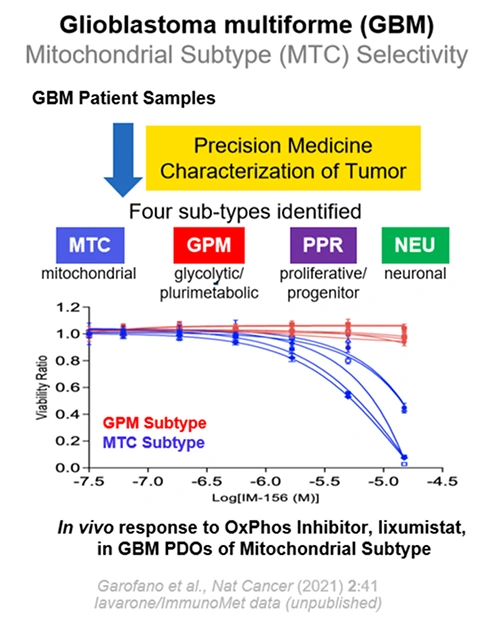
Tumor cell dependence on OxPhos activity has been documented across multiple cancer types, including tumors with an intrinsic dependence on OxPhos and those that develop dependence concomitantly with acquiring resistance to treatment. ImmunoMet's clinical approach includes focus on pancreatic cancer and GBM, as they represent both OxPhos-dependent intrinsic and acquired resistance.

Phase 1b/2a complete · MD Anderson Cancer Center

Window-of-Opportunity initiating Q3 26

BRAF / MEKi-resistant models

ER+, endocrine / CDK4·6-resistant
Sources: Janku et al., Investigational New Drugs, 2022 · El-Botty et al., Nature Communications, 2023 (breast) · Gopal et al., Clinical Cancer Research, 2019 (melanoma) · Garofano et al., Nature Cancer, 2021 (GBM). All cited in the investor deck.
See how OxPhos inhibition is translating into early efficacy in one of oncology's hardest indications.